IESA Vision Summit 2026 Inaugurated in Bengaluru, Charting India's Path from Design to Manufacturing: Synergy of Product, Production and Skilling
The India Electronics & Semiconductor Association (IESA), the nation’s premier industry body for the Electronics System Design and Manufacturing (ESDM) sector, today inaugurated the IESA Vision Summit 2026 at The Leela Bhartiya City Convention Centre, Bengaluru on 25th February, 2026. Bringing together the brightest minds from industry, government, and academia, the two-day summit — themed “Design to Manufacturing: Synergy of Product, Production and Skill” — signalled a decisive shift in India’s ambition to becoming a Product Nation.
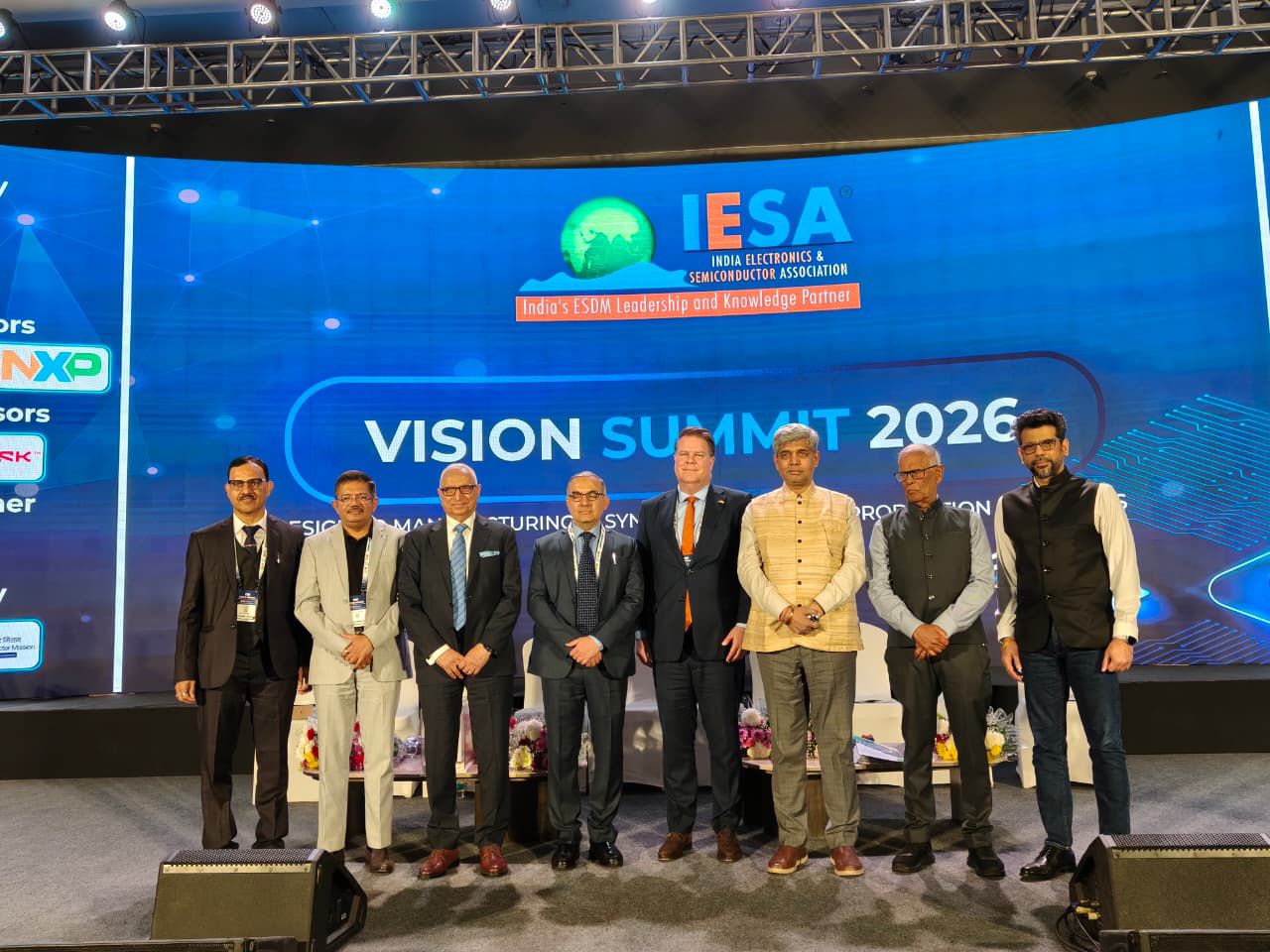 |
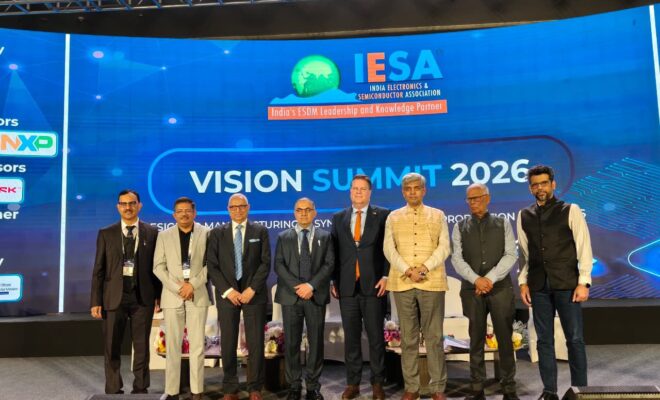
Shaping the future – IESA President Mr. Ashok Chandak (extreme left) inaugurates IESA Vision Summit 2026 alongside esteemed government dignitaries and industry leaders
The inauguration ceremony was addressed by a distinguished assembly of government leaders, industry luminaries, and stalwarts including Shri. Amitesh Kumar Sinha, (CEO, India Semiconductor Mission and Additional Secretary MeitY), Shri. Manish Chadha (JS, Ministry of Commerce & Industry, GoI), Dr. M M Tripathi (DG-NIELIT), Shri. Rahul Sharanappa, (IAS, Director, Deptt of ITBT, GoK), His Excellency, Ewout de Wit, Consul General, Embassy of Netherlands, Ajit Manocha, President, SEMI, Gilroy Mathew (CEO, UST), Mr Ashok Chandak, President, IESA, Ruchir Dixit, IESA Chairperson, VP & Country Manager Siemens EDA, Prof Tummala Rao, IDSPS and Emiretus Prof Georgia Tech, Advisor ISM.
A Theme That Defines a Movement
The 2026 edition’s theme — Design to Manufacturing: Synergy of Product, Production and Skill — captures what industry leaders describe as the most critical challenge and opportunity facing India’s electronics sector today: bridging the gap between world-class chip and product design capabilities and scalable, high-quality domestic manufacturing.
“India has already demonstrated global leadership in semiconductor design. The next step is clear — we must complete the value chain. We must Create, build, and manufacture world-class products at scale, with uncompromising quality and a deeply skilled workforce to sustain that growth.
India has the engineering talent to power the world. What we now need is the resolve to innovate boldly, the discipline to manufacture competitively, and the foresight to skill our people continuously — not just for India, but for the global technology ecosystem,” said Mr. Ashok Chandak, President, IESA, in his inaugural address.
“The IESA Vision Summit has, over the years, grown into far more than a conference — it has become a “national convergence platform” where ideas, partnerships, policy, innovation, and execution come together to drive real impact. This summit brings together “industry leaders, government policymakers, global investors, start-up innovators, academia, and ecosystem partners” — all united by a shared purpose: “to transform India into a global hub for semiconductor design, manufacturing, and innovation”, commented Mr. Ruchir Dixit, Chairperson IESA.
“India’s electronics manufacturing has grown sixfold in eleven years — a foundation built on policy conviction, industry trust, and global partnership. As we advance into the next phase of our semiconductor mission, we do so with a long-term resolve. India is working on designing various AI applications. Under NSM, Ministry of Electronics and IT is working on design and development of infrastructure that is required for AI. In ISM 2.0, support for design, Manufacturing and packaging will continue and will further expand for semiconductor ecosystem development. Research and Development (R&D) in cutting edge technologies and skilling will also be the key focus areas. India Semiconductor Mission is not only a government initiative, this is a journey of all stakeholders with a resolve to build a resilient, trusted, and future-ready supply chain that brings stability not just to one nation, but to the world,” said Shri. Amitesh Kumar Sinha, CEO & Additional Secretary, ISM, MeitY addressing the summit.
“Back when I stood up at San Francisco and predicted a $1 trillion semiconductor industry by 2030, I wasn’t thinking big enough. We’re already at $1 trillion — not by 2030, but as of today if we take in account the chips being designed and manufactured in-house by hyperscalers and major system companies-the industry has already crossed that threshold. So today, I’m putting a new stake in the ground: $2 trillion by 2035. That’s not a hope. That’s a strategic projection grounded in where this industry is heading — driven by AI, advanced packaging, and the insatiable demand for compute at every layer of the technology stack. We’ve surprised ourselves before. We’ll do it again. Prime Minister Modi invoked Moore’s Law at one of our SEMICONs, calling for India’s semiconductor industry likewise to grow exponentially now that the stars are aligned. The government has done its part. Now it’s up to the people of India to step up,” said Mr. Ajit Manocha, CEO and President, SEMI at the inauguration.
“The vision of sand-to-silicon ecosystems reflects India’s focus on building an integrated semiconductor ecosystem. We already have strong global leadership in chip design, with several global semiconductor companies operating design centers in India, contributing significantly to global chip design talent and innovation. Global trends indicate that the semiconductor value chains are becoming increasingly diversified and resilience-oriented. Nations are seeking trusted partners for manufacturing, design, packaging, and components. Through the strategic trade agreements, market access negotiations and export promotion frameworks, we are expanding opportunities for India’s electronics and semiconductor industry in the global markets. Our objective is not just participation, but leadership in targeted segments of the global electronics trade ecosystem,” said Shri. Manish Chadha, Joint Secretary Ministry of Commerce and Industry at his inaugural address.
“Karnataka isn’t just participating in India’s electronics revolution — we’re leading it. From being the first TCC in the ESDM space in 1985, to contributing 46% of national electronics sales, hosting 500+ R&D centers, 100+ chip design centers, and global giants – our story is one of pioneering leadership. Our policies — from the Karnataka ESDM Policy to being the first state with a dedicated GCC Policy — reflect our unwavering commitment to growth. The IESA Vision Summit is the ideal platform to amplify this story to the world,” said, Shri Rahul Sharanappa Sankanur, IAS, Director, Dept. of E, IT and Bt, GoK; Managing Director, KITS
“The electronics and semiconductor sector is perhaps the clearest example of what coordinated national intent can truly achieve. In over three decades of my association with this industry, I have never witnessed such an extraordinary alignment of vision and execution — with multiple central ministries, including MeitY, the Ministry of Commerce, and the Department of Science & Technology, working in sync with nine proactive state governments and industries under harmonized electronics and semiconductor policies. At IESA, our responsibility is to ensure that industry, academia, and government move forward in formation — aligned in purpose, speed, and direction.
‘Design to Manufacturing’ is not merely a theme; it is a strategic national imperative. India is positioning itself to be a Product Nation, a Production Nation, and a Skills Nation. And this summit marks the moment we confidently declare that ambition to the world,” continued Mr. Ashok Chandak, President, IESA.
The most Impactful development at the IESA Vision Summit, the official formation of IDSPS (Indian Design, Semiconductors, Packaging and Systems) — was announced as a dedicated division under IESA, marking a significant milestone for India’s semiconductor R&D landscape. The division, formed with active participation from industries and Institutes will be led by Dr. Prof. Rao Tummala, appointed as CEO of the division and is envisioned to build a long-term R&D for manufacturing technology needs spanning 3, 5, and even 10 years ahead into the future — with ambitions that extend well beyond national boundaries to create global impact.
Other highlights:
One of the most significant highlights of this year’s summit included Grand Finale of the IESA DeepTech Hackathon 2026, a national competition (having 900+ registrations) that challenged India’s brightest engineering minds to build practical, industry-ready solutions in the country’s most strategically critical technology domains.
The summit also set the stage for one of the most anticipated traditions in India’s ESDM calendar — the IESA Technovation Awards 2026, the sector’s most prestigious recognition since their institution in 2008.
The Vision Summit 2026 set a landmark gathering by bringing together over 1,500 delegates alone on the 1st day for a dynamic exchange of ideas and innovation. Featuring 30+ keynote addresses and 7 insightful panel discussions, the summit showcased 100+ booths. The vibrant Startup Zone and dedicated skilling workshops enlightened aspiring students from top engineering colleges. Along with a State Pavilion, Technovation Awards, Startup Mitra Sessions, Hackathon challenges and product launches the large-scale ecosystem exhibition offered unparalleled opportunities for networking, collaboration, and business development across the ESDM sector.
About IESA Vision Summit
The IESA Vision Summit is India’s foremost annual event for the Electronics System Design and Manufacturing sector, organized by the India Electronics & Semiconductor Association (IESA). Each year, the summit brings together thousands of industry leaders, policymakers, innovators, startups, and academics to shape the strategic direction of India’s ESDM ecosystem. The 2026 edition is being held on February 25–26, 2026, at The Leela Bhartiya City Convention Centre, Bengaluru.
About IESA
The India Electronics & Semiconductor Association (IESA) is India’s premier industry body for ESDM and Intelligent Electronics. Working at the intersection of government policy, industry, and academia, IESA’s mission is to establish India as a leading global hub for electronics manufacturing and design — and to harness the power of technology to positively impact the lives of over a billion Indians.
For more information, visit: www.iesaonline.org | www.iesa-visionsummit.com